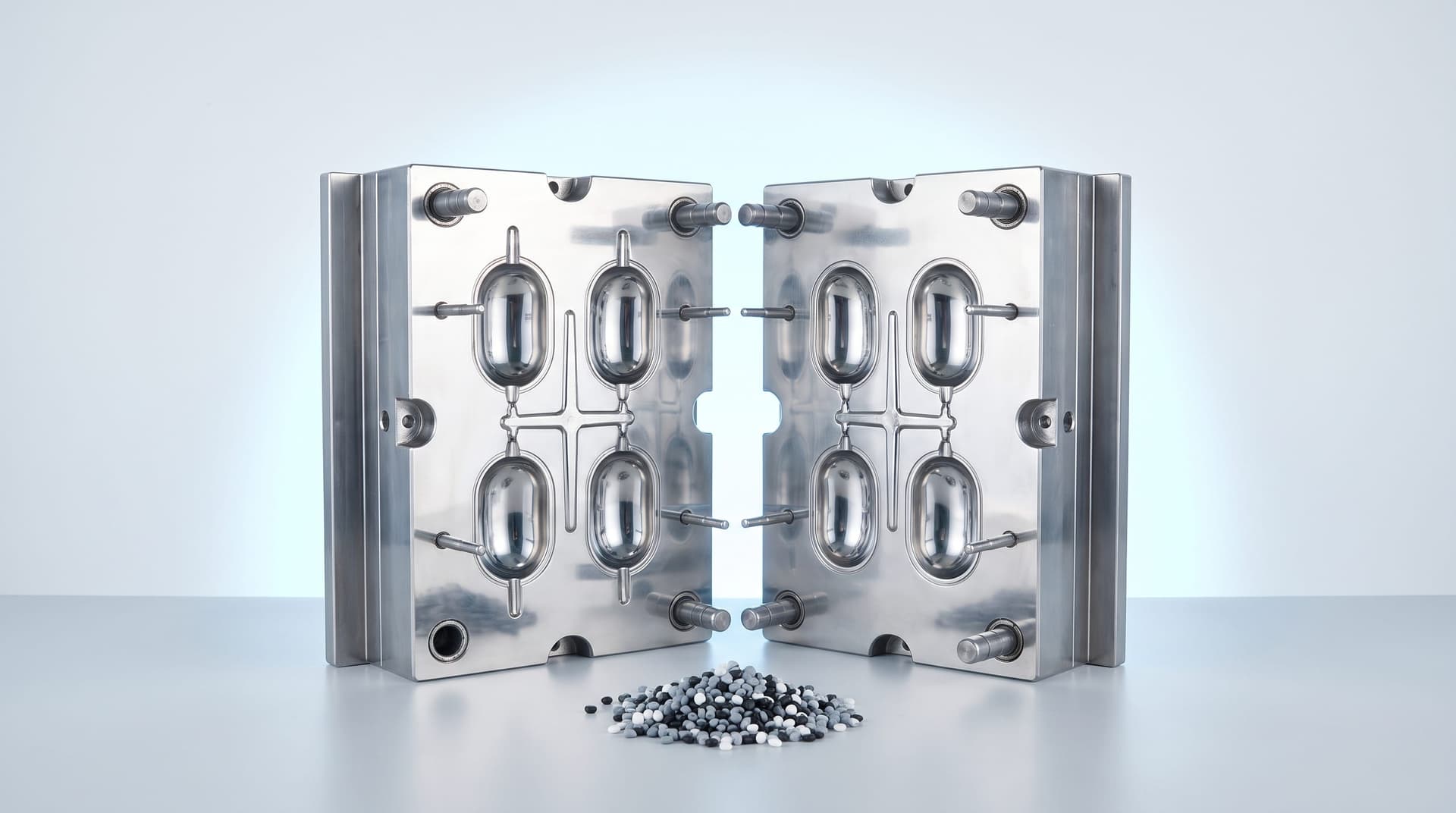
Learn how aluminum and soft-steel tooling drastically compress lead times while providing production-grade mechanical properties.
Bridge tooling using aircraft-grade aluminum (QC-10 / 7075-T6) allows product developers to validate market fit and conduct clinical or regulatory trials with genuine production polymers (ABS, PC, PEEK, TPU) in as few as 10 to 14 days, saving up to 60% compared to high-volume hardened steel molds. Because the part comes off a real injection press rather than a 3D printer, teams get accurate shrinkage, weld-line behavior, and mechanical properties well before committing to a hardened production tool — the data that actually derisks the transition to volume manufacturing.
- Rapid tooling enables true production-polymer validation before cutting high-volume steel.
- Aluminum tooling significantly accelerates cycle times due to high thermal conductivity.
- Easily make geometry modifications on aluminum molds during beta testing phases.
1. QC-10 Aluminum vs. P20 Steel for Rapid Tooling
Aluminum dissipates heat up to 5x faster than steel, dramatically shortening cycle times and cooling uneven cross-sections with less warpage.
- Lead Times: 10 to 14 days from CAD release to parts on hand.
- Tool Life: 2,500 to 25,000 shots depending on resin abrasiveness.
- Cost Savings: 40% to 60% lower tooling investment than production steel molds.
Actionable Manufacturing Recommendations
Use rapid tooling to bridge the gap between 3D printed functional prototypes and full-scale production. Sango CNC delivers rapid bridge molds in as fast as 10 business days.
Need a competitive manufacturing quote?
Upload your 3D CAD files for instant pricing, engineering review, and automated DFM feedback.